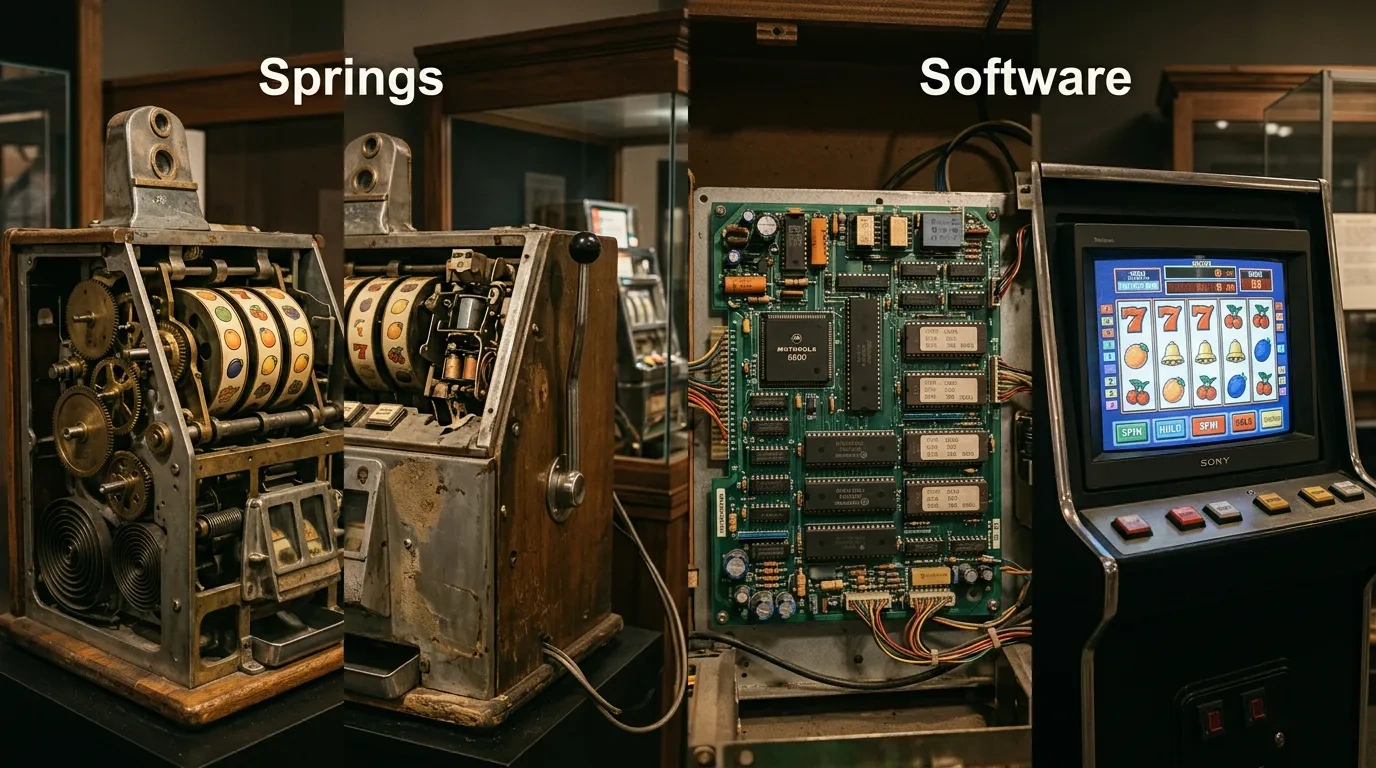
Slot mechanics have evolved over the past century. Early machines featured physical reels, while later designs introduced new systems. Today, many sites offer slots that operate through software. US players have several options. Some choose three-reel steppers, while others prefer Megaways games. Megaways slots can create up to 117,649 possible combinations on a single spin.
Core Principles Of Slot Operation
The workings of a slot machine focus on one action: figuring out the result of a spin. This section looks at the steps that change a player’s spin trigger into a visible result and how payouts are assessed. Once the spinning starts, the machine takes the input, creates or gets the value for the outcome, and matches that result to the symbols displayed on the reels or screen. The system checks the setup against the paytable to see if there’s a winning combination. Credits get taken off before the spin, and any eligible payout gets added afterward. Modern slots handle these calculations electronically, and the spinning reels mainly show the outcome to the player.
| Aspect | Detail |
| Spin trigger | Player presses the button |
| Reels | Vertical columns display symbols |
| Rows | Horizontal positions across reels |
| Symbol display | Result appears after spin |
| Outcome evaluation | Software checks symbol arrangement |
| Win recognition | Paytable identifies qualifying combinations |
| Paytable role | Lists payouts for qualifying combinations |
| RNG vs mechanical | Software replaces physical components |
| Animation timing | Display follows outcome determination |
Origins Of Three Reel Steppers
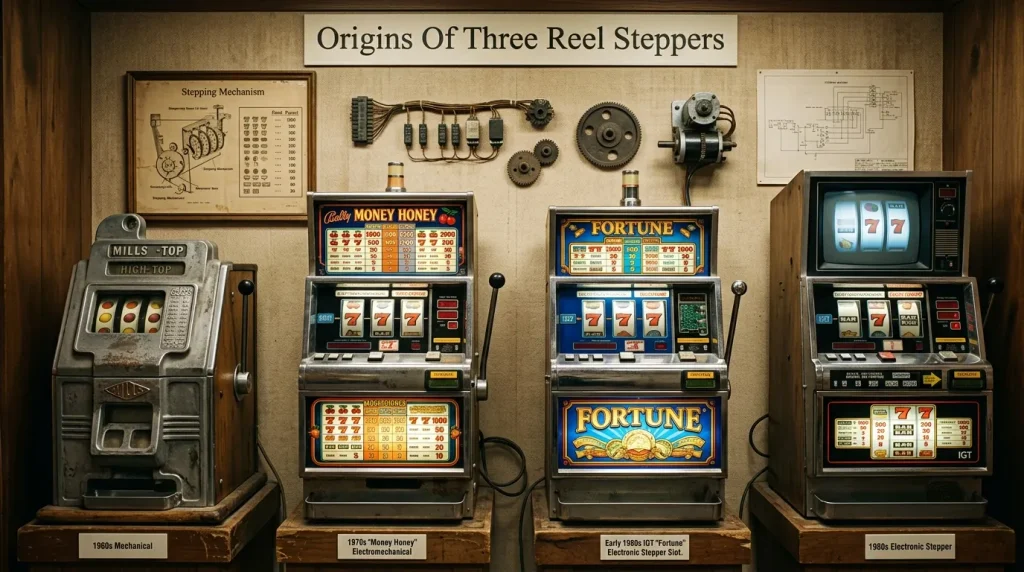
Back in the day, Charles Fey came up with the Liberty Bell design that really changed the game for gambling machines around 1895. This three-reel setup made it a lot easier to work out the math involved, bringing down the number of possible outcomes to a level that was much simpler to deal with. It also made it practical to build the machines and figure out payouts using springs, levers, and mechanical stops. Stepper slots have a history that goes back to this original design, which capped the possible combinations at 1,000 when there were ten symbols on each reel. For years, traditional 3 reel slot machines ruled the casino area, thanks to their mechanical workings and the way they assessed wins.
| Feature | Details |
| Year | 1895 |
| Inventor | Charles Fey |
| Reel Count | Three mechanical reels |
| Symbol Count | Five distinct symbols |
| Main Symbols | Horseshoes diamonds spades hearts bells |
| Payline Count | Single horizontal line |
| Max Payout | Ten nickels |
| Construction | Springs cams levers physical reels |
Symbols And Paytables In Early Slots
Back in the early games, how symbols were designed and the layout of the paytable determined how often you’d win and how much you’d get paid out. These features built the base for various types of slot machine mechanics, since each reel had a set number of physical stops and symbols. Higher-value icons showed up less frequently, while the lower-value symbols took up more spots on the reels and led to smaller payouts. The paytable displayed the combinations that earned prizes and what each outcome paid out. Most early machines had just one main payline, meaning only the symbols that lined up on that line were taken into account. Since reel strips were tangible, designers found it hard to adjust symbol frequency without swapping or altering the reels directly.
- High-tier versus low-tier symbols;
- Frequency inversely related to value;
- Three matching tops paid most;
- Central payline determined qualifying wins;
- Bonus symbols appeared later;
- Physical strips restricted symbol distribution.
Transition To Electromechanical Designs
In the 1960s, electromechanical designs combined mechanical spinning reels with electronic control systems. Money Honey and other similar machines swapped out certain mechanical controls for electrical parts, allowing for bigger automatic payouts while still featuring the classic visible reels. This change played a part in shaping the retro slot machines that players recognize today. These mixed systems got the industry ready for completely digital video formats.
| Feature | Description |
| Power source | Electric motor system |
| Reel control | Electronic stop mechanism |
| Payout system | Automatic coin distribution |
| Lever role | Optional player interface |
| Coin capacity | Up to 500 coins |
| Security features | Electronic fraud detection |
| Sound effects | Amplified audio signals |
| Design era | 1963 through 1970s |
Growth Of Video Reel Games
Fortune Coin created the first screen-driven slot in 1976. The team used a Sony television, modifying it to take the place of traditional mechanical strips. In 1996, WMS introduced Reel ‘Em In, marking the first American slot to feature a second-screen bonus round. These developments shifted the direction of slot design.
- Screen-based reel displays;
- Extra symbols beyond physical limits;
- Multi-line layouts;
- Themed art and animation;
- Bonus screens;
- Variable math models.
Fixed Paylines And Line Calculations
Mechanical steppers featured a single payline. With the introduction of video slots, more lines became available. Fixed paylines are specific paths that run across the reels. Players win when matching symbols line up on these paths. In most games, paylines move from left to right, and the symbols must appear on adjacent reels.
| Feature | Single Line | Three Lines | Nine Lines | Twenty Lines |
| Line Geometry | Horizontal center only | Horizontal and diagonal | Zigzag and V-shaped | Complex mixed patterns |
| Activation Options | Always active | Select one or more | Select one or more | Select one or more |
| Hit Rate Impact | Lowest frequency | Moderate frequency | Higher frequency | Highest frequency available |
Ways To Win Beyond Paylines
Ways-based systems do not use lines. Instead, these games look for matching symbols on adjacent reels. Wins always begin with the leftmost reel. To win, players must land the required symbols in order on each reel, following the rules of the game. For a game with five reels and three rows, there are 243 ways to win, which comes from multiplying 3 by itself five times. If a game has five reels and four rows, there are 1,024 ways to win, calculated by multiplying 4 by itself five times. Most ways-to-win games keep the same number of rows on every reel.
| Format | Typical Layout | Winning Structure | Main Difference |
| Fixed Paylines | 5 reels × 3 rows | Symbols must follow predefined lines | Winning paths are fixed |
| 243 Ways | 5 reels × 3 rows | Matching symbols across adjacent reels | No specific row alignment required |
| 1,024 Ways | 5 reels × 4 rows | Matching symbols across adjacent reels | More symbol positions per reel |
| Megaways | Variable reel heights | Winning ways change with reel configuration | Number of ways can vary from spin to spin |
| Cluster Pays | Grid-based layout | Wins form through connected symbol groups | Does not rely on traditional paylines or left-to-right paths |
RNG-Based Reels And Outcome Mapping
Slots rely on random number generators that continuously produce values, regardless of the player’s actions. Each value corresponds to a specific position on the internal reels. These internal reels include more stops than are shown on the visible reels. When the generator selects a value, the software assigns it to one of the internal stops. Developers use this system to determine the odds for each symbol, yet the visible reels never change in appearance. After the software selects a value, the game displays the symbols and compares the result to the paytable.
| Technical Element | Description |
| RNG cycle | Generates values continuously every millisecond |
| Seed | Initial value starts number sequence |
| Mapping table | Connects numbers to internal positions |
| Internal stops | Reel contains more positions internally |
| Weighting symbols | Assigns frequency to each symbol |
| Outcome lock moment | Locks at the moment the spin button activates |
| Audit testing | Third parties verify RNG distribution |
| Effect on fairness | Prevents prediction or manipulation attempts |
Wild Symbols And Scatter Triggers
Symbols shape how slot machines work in several ways. Wild symbols substitute for other symbols to form combinations. Game designers place wilds on paylines and within different setups. Some wilds also include multipliers that raise the payout. Scatter symbols follow their own rule. They do not have to appear on a payline. Scatters can trigger free spins, open bonus rounds, or pay out independently. Game designers determine the payout amounts for scatter symbols. Some scatters also apply multipliers. The rules and paytables define the function of each symbol.
- Standard wilds: substitute for basic symbols;
- Expanding wilds: cover entire reel;
- Sticky wilds: remain for multiple spins;
- Walking wilds: move across reels;
- Stacked wilds: occupy multiple positions;
- Anywhere pays: scatters pay in any position;
- Free spin triggers: scatters activate bonus rounds;
- Feature entries: scatters unlock special modes;
- Minimum counts: three scatters commonly required.
Cascading Reels And Repeated Wins
Cascading reels conduct multiple result checks within a single paid spin. When players land a winning combination, the game pays out and removes the matching symbols. The empty spaces are then filled as existing symbols drop down and new ones appear. This process can lead to additional wins without requiring another bet. The cycle continues until the reels show no more winning combinations. Some games use a variation where each cascade increases the multiplier. Others combine cascading mechanics with ways-to-win systems. Megaways games frequently feature cascading reels and adjust reel heights on every spin.
- Winning symbols disappear after payout evaluation;
- Remaining symbols shift into open positions;
- New symbols enter the grid;
- The game evaluates refreshed combinations again;
- Consecutive cascades can create multiple wins;
- Multipliers can increase during a cascade sequence;
- Ways-to-win and Megaways formats can expand combination possibilities.
Free Spin Features And Modifiers
Free spin rounds begin when a player lands the required number of scatter symbols, often three or more, in a single spin. In these rounds, the gameplay may shift. The reels can change, symbol values may be adjusted, and multipliers can appear. Wild symbols sometimes behave differently. The game may also introduce new ways to win. Some slots let players earn extra free spins by retriggering, which occurs if additional scatters appear during the free spin rounds without placing another bet. Each slot determines its own rules for scatters, retrigger limits, reel layout, and bonus features. Players should review the paytable or feature section before playing to understand each game’s structure.
- Locked reels: Selected reel positions remain fixed during the feature;
- Progressive multipliers: Win multipliers increase with each consecutive win in the round;
- Upgraded symbols: Certain symbols receive higher values;
- Expanded ways: More winning combinations become available;
- Scatter triggers: Three or more scatters commonly activate the feature;
- Retriggers: Additional scatters award extra free spins;
- Sticky wilds: Wild symbols remain in place across several spins;
- Extra scatter awards: Additional scatter combinations can provide rewards;
- Maximum reel heights: Some games activate larger reel configurations;
- Extended retriggers: Certain games allow repeated retriggers under their rules.
Volatility And Win Distribution
Volatility shows how much a slot pays and how often players get those wins over many rounds. Low-volatility slots pay out more often, but each win tends to be smaller. High-volatility slots pay amounts, but players wait longer between wins. Medium-volatility games fall in the middle. Win sizes and frequency both balance out. Players use volatility to choose slots that fit their session length, spending preferences, and patience for waiting between wins.
| Volatility Level | Hit Frequency | Average Win Size | Session Swings | Bonus Dependence | Player Profile Fit |
| Low | Frequent small wins occur | Awards remain relatively modest | Bankroll fluctuates less dramatically | Bonuses add modest enhancement | Casual extended session preference |
| Medium | Moderate win intervals appear | Mid-range awards balance returns | Moderate swings require planning | Bonuses contribute noticeable boosts | Balanced risk tolerance players |
| High | Wins appear infrequently | Large awards dominate payouts | Extreme swings demand reserves | Bonus rounds produce primary payouts | High-risk aggressive players |
RTP Percentages In Slot Design
RTP means return to player. This is the percentage of total bets a slot machine gives back to players over many spins. A slot with 96% RTP predicts about $96 will return for every $100 players wager over time. The house keeps the other 4%. Other factors also affect how and when the game pays out, such as volatility, bonus rounds, symbol values, and prize distribution.
- Large sample sizes: RTP becomes meaningful over extensive play;
- House edge: Calculated as 100% minus the stated RTP;
- Different volatility: Games with identical RTP can distribute wins differently;
- Bonus contributions: Feature rounds can form part of the return model;
- Game variations: Different versions of the same game can use different RTP settings;
- Short-term results: Individual sessions can vary widely from the theoretical percentage.
Classic Steppers Compared With Modern Types
Classic 3-reel slot machines feature physical reels with fixed symbols and use single-line evaluation. Players win when the right symbols align on that single line, which limits outcomes. Older steppers differ in design and payout potential from modern digital formats. In contrast, modern video and Megaways formats have multiple reels, expanded symbol sets, and can vary reel height. These features allow them to generate thousands of possible winning paths.
| Feature | Classic | Modern |
| Reels | Three physical reels | Five or six reels |
| Symbols | Five to ten symbols | Dozens of symbols |
| Paylines | One central line | Up to 100 lines |
| Ways | Fixed at reels × symbols | Up to 117,649 ways |
| Bonus Depth | No bonus rounds | Multi-level cascades and spins |
| Volatility Range | Low volatility only | Low to extreme volatility |
| Typical Players | Traditional casino visitors | Online and mobile users |
Cluster Pays And Line Slots Compared
Cluster games follow a specific approach. Rather than paylines, some games rely on clusters. Players win when matching symbols form a group by touching across rows or columns on the grid. When the game detects a cluster, it removes those symbols from the grid. New symbols drop into the empty spaces. Sometimes, this leads to the formation of additional clusters.
- Fixed paylines: Wins follow predetermined paths across the reels;
- Cluster formation: Matching symbols must connect in groups;
- Grid layouts: Cluster games often use larger reel structures;
- Adjacent symbols: Connections form horizontally or vertically;
- Minimum cluster size: A required number of matching symbols must connect;
- Cascading wins: Winning clusters can disappear and create new combinations;
- Paytable rules: Each game defines qualifying cluster sizes and payout values.
Megaways Engine Structure And Reels
In 2016, Big Time Gaming introduced the Megaways engine. The Megaways system uses reels that vary in height instead of fixed reels, and the number of symbols on the reels changes with each spin.
| Aspect | Specification |
| Reel count | Six reels standard configuration |
| Minimum height | Two symbols per reel |
| Maximum height | Seven symbols per reel |
| Typical symbol counts | Two to seven vary |
| Adjacency rules | Consecutive reels left to right |
| Base game layout shifts | Every spin recalculates height |
| Effect on visual complexity | Extreme variation per spin |
Calculating Megaways Combination Counts
Megaways slots have reels that shift with every spin, changing the number of ways to win each round as the game recalculates possible outcomes. Players form combinations when symbol positions on qualifying reels are multiplied during a spin. Unlike traditional slots with fixed paylines, Megaways games use this dynamic method.
| Reel Configuration | Calculation | Total Ways | What It Shows |
| 2 symbols on 6 reels | 2 × 2 × 2 × 2 × 2 × 2 | 64 | Lower-end reel configuration |
| 3 symbols on 6 reels | 3 × 3 × 3 × 3 × 3 × 3 | 729 | More positions create additional paths |
| 5 symbols on 6 reels | 5 × 5 × 5 × 5 × 5 × 5 | 15,625 | Larger reel heights expand combinations |
| 7 symbols on 6 reels | 7 × 7 × 7 × 7 × 7 × 7 | 117,649 | Common maximum in classic Megaways setups |
| Variable reel heights | Multiply each reel’s visible positions | Changes each spin | Total ways depend on the current layout |
Combined Megaways Features In Practice
Megaways games combine several elements: reel heights, symbols, multipliers, wilds, and free-spin options all influence gameplay. With each spin, the reels shift, altering the number of possible winning combinations. Cascades display the outcomes from a single paid spin. Players encounter these mechanics when specific combinations appear. Multiplier ladders raise values as players achieve consecutive wins. Some wilds expand to cover entire reels, while others remain fixed in place. Free-spin rounds may introduce new reel arrangements or add modifiers.
- Cascades with multipliers: Consecutive wins can increase multiplier values;
- Maximum-height reels: Selected features can activate larger reel configurations;
- Expanding wilds: Wild symbols can cover additional positions;
- Stacked symbols: Multiple matching symbols can appear together on a reel;
- Mystery symbols: Identical hidden symbols can reveal the same symbol type;
- Free-spin modifiers: Bonus rounds can introduce additional mechanics;
- Retriggers: Qualifying scatters can extend an active free-spin feature.
Timeline Of Slot Mechanic Evolution
The history of stepper slots connects the Liberty Bell with modern engines. The timeline presents key dates, beginning with early mechanical designs and moving through electromechanical developments. It also includes video formats and marks the arrival of variable-reel systems.
| Year | Event |
| 1895 | Liberty Bell introduced |
| 1900s | Early mechanical era |
| 1963 | Money Honey released |
| 1976 | Fortune Coin video debut |
| 1996 | Reel ‘Em In launched |
| 2000s | Ways-to-win math emerged |
| 2016 | Megaways engine introduced |
Comparing Different Slot Mechanics As A Player
Slot machine mechanics shape the way players win, the frequency of bonus rounds, and the distribution of payouts over time. Developers add features like cascading reels or multipliers, which influence results. A fixed-payline slot works in a different way compared to a Megaways or cluster-pay game. The game details show the reel layout, paylines or ways to win, RTP, bonus rules, and the minimum stake.
- Check the number of reels and visible rows;
- Identify whether the game uses paylines, ways, clusters, or another format;
- Review the stated volatility level;
- Find the RTP percentage in the game information;
- Read the rules for free spins, cascades, wilds, and multipliers;
- Check the minimum and maximum available bet;
- Review the paytable prior to real-money play.
Mechanical And Digital Detail Summary
Mechanical slots determine outcomes using reel stops. In contrast, video and digital slots rely on random number generators and display results through software. Online casino slots developed from earlier mechanical and electromechanical versions. Modern formats include Megaways and cluster games. Features may include variable reels, cascading symbols, multipliers, wilds, and bonus rounds.
| Type | Outcome Control | Reel Structure | Feature Depth | Typical Volatility | Common Setting |
| Mechanical | Physical reel stops | Three fixed reels | Minimal | Low | Vintage collections and older venues |
| Electromechanical | Motor-assisted mechanical system | Three to five fixed reels | Basic paylines and simple features | Low to medium | Older land-based slots |
| Early Video | RNG with screen display | Three to five fixed reels | Multiple paylines | Medium | Land-based casinos |
| Advanced Video | RNG with animated display | Five fixed reels | Cascades, free spins, bonus rounds | Medium to high | Land-based and online casinos |
| Megaways | RNG with variable reel heights | Commonly six variable reels | Cascades, multipliers, changing ways | High | Online casinos |
| Cluster Games | RNG with grid layout | Grid rather than standard reels | Cluster wins, cascades, special wilds | Medium to high | Online casinos |
Modern Online Slot Types Overview
Today, players can find a variety of online casino slot games available on digital platforms throughout the United States. The variety of today’s online casino slots includes classic stepper games, multiline video options, ways-to-win setups, cluster grids, and Megaways systems. Each category has unique reel designs and ways to assess payouts.
- Classic three-reel slots: traditional symbols and paylines;
- Multiline video slots: up to 100 fixed paylines;
- 243-ways configurations: adjacent reel matching systems;
- Megaways engines: variable reel heights to 117,649 ways;
- Cluster grid slots: grouped symbol matching mechanics;
- Branded-style themes: film and television artwork integration.
Retro Machines As Educational Exhibits
Older cabinets preserve the mechanical systems found in retro slot machines. They allow people to examine gambling technology from before the introduction of software-based systems. A technology exhibit may display mechanical steppers, electromechanical controls, reel assemblies, payout hoppers, and printed paytables. Visitors can observe the progression of slot machines, beginning with lever-operated cabinets and mechanical reels, then advancing to electronic controls and screen-based games. Museum and historical collection staff arrange working examples so visitors can study engineering and interface design up close.
- Mechanical reel assemblies;
- Coin-accepting payout hoppers;
- Internal wiring and control systems;
- Pull-lever activation mechanisms;
- Glass-printed paytables;
- Physical buttons and switches;
- Electromechanical components;
- Differences between vintage cabinets and modern displays.
Conclusion
Over the last hundred years, engineers shifted slot machines from mechanical designs to video formats. The Liberty Bell, with its three drums and five symbols, influenced how later machines were built. After that, engineers added electromechanical components. Eventually, manufacturers replaced physical reels with video screens, so spinning reels are now managed by digital systems. Software, rather than physical stops, determines the game results. Some slot machines feature Megaways engines, allowing a single spin to produce as many as 117,649 possible combinations. In the United States, players can review reel layouts, volatility levels, and bonus features to choose games that match their preferences.
FAQ
What Is The Safest Way To Test A New Slot Mechanic?
Start with demo mode, check the paytable and feature rules, and review RTP and volatility. For real-money play, use small stakes and set spending and time limits.
How Much Do Megaways Slots Pay Compared With Classic Steppers?
Megaways and classic slots can have similar RTP percentages, but payout patterns differ. Megaways games often use variable reels and bonus features, which can create higher volatility.
Which Slot Mechanics Are Easiest For Beginners?
Three-reel and simple fixed-payline slots are usually easier to understand because their reel layouts, paylines, and payout rules are more direct than Megaways or cluster-pay formats.